
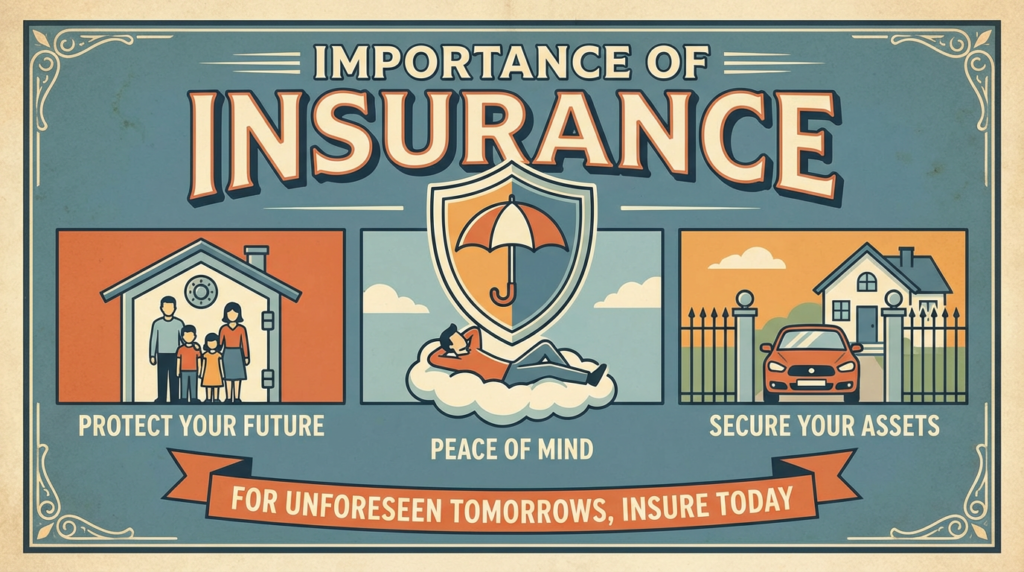
In the grand architecture of financial planning, most people are obsessed with the “roof”—the visible gains from stock market investments, real estate portfolios, and high-interest savings accounts. While everyone wants to talk about how to grow their wealth, few want to discuss how to protect it.
Life is inherently volatile. We live in a world governed by “Black Swan” events—unpredictable, high-impact occurrences that can change the trajectory of our lives in an instant. A sudden illness, a natural disaster, an automobile accident, or the untimely passing of a breadwinner are not just emotional tragedies; they are financial earthquakes.
This is where insurance comes in. It is not merely a “product” you buy from a salesperson; it is a sophisticated mechanism for risk transfer. It is the only financial tool that provides a guaranteed “Plan B” when “Plan A” falls apart.
In this exhaustive guide, we will explore why insurance is the single most important component of your financial life, looking at its impact on the individual, the family, the business, and the global economy.
Part 1: The Philosophy of Risk and the History of Safety
To understand the importance of insurance, one must first understand Risk. Every action we take involves risk. Driving a car involves the risk of collision. Owning a home involves the risk of fire. Simply living involves the risk of falling ill.
The Law of Large Numbers
Insurance operates on a mathematical principle known as the “Law of Large Numbers.” In simple terms, it is the practice of “pooling.” A large group of people (the insured) pay a small amount of money (the premium) into a collective pool. Because it is statistically unlikely that everyone in that pool will experience a catastrophe at the exact same time, the money in the pool is used to pay for the losses of the few who do.
In essence, insurance is a social contract. It is the many coming together to protect the one.
From Ancient Traders to Modern Policyholders
The concept isn’t new. Ancient Chinese traders used to distribute their goods across several ships so that if one vessel sank, the loss wouldn’t bankrupt them. In the 17th century, Lloyd’s Coffee House in London became the birthplace of modern marine insurance, where merchants and sailors shared the risks of the sea.
Today, that same logic applies to your life, your health, and your assets.
Part 2: Protecting Your Greatest Asset – Your Income
Most people believe their house or their car is their most valuable asset. They are wrong. For the average person, their Human Life Value—the ability to work and earn an income over the next 20 to 30 years—is worth far more than any physical property.
Why Life Insurance is Non-Negotiable
If you earn $50,000 a year and plan to work for 30 more years, you are effectively a $1.5 million asset. If you are no longer there to earn that money, your family loses $1.5 million in future cash flow.
Life insurance is the only tool that can instantly create an estate where none existed.
- Debt Clearance: It ensures that your mortgage, car loans, and personal debts are not passed on to your grieving family.
- Goal Protection: It ensures that your children can still go to the college you dreamed of, even if you aren’t there to pay the tuition.
- Lifestyle Maintenance: It allows your spouse to maintain their standard of living without having to take on three jobs or sell the family home.
Without life insurance, a family’s financial future is left entirely to chance. With it, their future is a certainty.
Part 3: Health Insurance – Guarding the Gates of Wealth
We are currently living through an era of unprecedented medical advancement, but these miracles come with a staggering price tag. Medical inflation is consistently outpacing general inflation.
The Bankruptcy of the Uninsured
In many parts of the world, medical bills are the leading cause of personal bankruptcy. A single week in the Intensive Care Unit (ICU) can wipe out a decade of savings.
Health insurance is important because:
- It preserves your “Wealth Bucket”: You might be saving for a house or retirement. Without health insurance, a single surgery forces you to dip into those buckets. You aren’t just losing the money; you are losing the years of compound interest that money would have generated.
- Access to Quality Care: Insurance allows you to choose the best doctors and the best hospitals based on medical need, not based on what you can afford out of your pocket.
- Preventative Healthcare: Modern insurance plans often include free annual check-ups, vaccinations, and screenings. This “maintenance” catches problems early, saving both your life and your money in the long run.
Part 4: Asset Protection – Defending What You’ve Built
If you have worked hard to buy a home or a car, that asset represents thousands of hours of your labor. Losing it to a fire, a flood, or a theft is effectively losing those thousands of hours of your life.
Homeowner’s and Renter’s Insurance
Your home is likely your largest investment. Insurance doesn’t just cover the structure; it covers the contents and, crucially, Liability. If someone slips and falls on your property, a lawsuit could cost you more than the house itself. Insurance provides a legal defense and pays the settlements.
Auto Insurance
Beyond protecting your vehicle, auto insurance is about social responsibility. It protects the third parties you might accidentally harm. It ensures that if you cause an accident, the victim’s medical bills are paid, and your own legal liabilities are managed.
Part 5: The Psychological Benefit – Peace of Mind
The most underrated benefit of insurance is psychological. The “Stress of the Unknown” is a significant drain on human productivity and happiness.
When you are adequately insured, you carry a “mental safety net.”
- You drive with less anxiety.
- You sleep better knowing your family is secure.
- You are more willing to take calculated risks in your career or business because you know your foundation is solid.
This peace of mind isn’t just a feeling; it’s an economic driver. People who feel secure are more likely to invest, spend, and contribute to the economy than those who are living in a state of financial fear.
Part 6: Insurance as a Business Catalyst
Without insurance, the modern business world would grind to a halt. No bank would lend money to a business to build a skyscraper or a factory if that asset couldn’t be insured.
1. Liability Protection
In our litigious society, businesses face constant threats from slip-and-fall accidents, professional errors, and “Errors and Omissions.” Liability insurance allows entrepreneurs to innovate without the constant fear of one mistake ending their company.
2. Employee Benefits and Retention
Group health insurance and life insurance are key tools for attracting and retaining talent. When employees feel that their employer cares about their health and their family’s security, loyalty and productivity increase.
3. Business Continuity
What happens if a key partner in a business dies? Without “Key Person Insurance,” the business might have to be liquidated to pay out the deceased partner’s heirs. Insurance provides the liquidity to keep the doors open and the staff employed.
Part 7: The Macroeconomic Impact – How Insurance Fuels Nations
On a larger scale, the insurance industry is one of the biggest investors in the global economy.
Infrastructure Development
Insurance companies collect billions in premiums. Since they don’t need to pay all that money out immediately, they invest it. Because insurance liabilities are long-term (especially life insurance), these companies invest in long-term projects like highways, bridges, airports, and power plants.
Reducing the Burden on the State
When people have private health and life insurance, the government has to spend less on social welfare, public hospitals, and emergency aid. This allows tax dollars to be used for other developmental purposes.
Stability During Disasters
Following a massive earthquake or hurricane, the immediate influx of insurance claim money is what allows cities to rebuild. Without insurance, the economic recovery from natural disasters would take decades instead of years.
Part 8: Common Myths and the High Cost of Neglect
Despite its clear benefits, many people remain under-insured or completely uninsured. This is often due to pervasive myths.
Myth 1: “Insurance is a waste of money if I don’t get a claim.”
Reality: You are paying for the transfer of risk. If you don’t file a claim, it means you had a safe, healthy year—which is the best-case scenario. The premium was the “fee” for the peace of mind you enjoyed for 365 days.
Myth 2: “I’m too young to need insurance.”
Reality: Youth is the best time to buy. This is when you are most “insurable.” As you age, your health declines, and insurance becomes either very expensive or impossible to get. Buying young “locks in” your insurability.
Myth 3: “I can save the money myself instead.”
Reality: If you save $100 a month for a year, you have $1,200. If you have a $50,000 heart surgery in month 13, your “self-insurance” fails. Real insurance provides a $50,000 benefit from Day 1.
Part 9: How to Build an Effective Insurance Portfolio
A 3,000-word guide would be incomplete without a roadmap for action. How much insurance do you actually need?
The Hierarchy of Needs
- Health Insurance: This is the first priority. It protects your current cash flow and savings.
- Term Life Insurance: If anyone depends on your income, you need at least 10–15 times your annual income in life cover.
- Disability Insurance: You are more likely to become disabled during your working years than you are to die. Disability insurance replaces your paycheck if you can’t work.
- Critical Illness Cover: A lump sum payout upon the diagnosis of a major illness (Cancer, Stroke) to cover the “hidden costs” like lifestyle changes or experimental treatments.
- Asset Insurance: Home and Auto.
The “Rule of 10”
A simple starting point: Aim for a Life Insurance sum assured that is 10x your annual salary, and a Health Insurance cover that is at least 50% of your annual salary (or a minimum of $10,000–$20,000 depending on your region’s healthcare costs).
Part 10: Conclusion – The Moral and Financial Mandate
Insurance is often sold through fear, but it should be bought through love and logic.
It is an act of love for your family, ensuring they never have to beg for money or leave their home if you are gone. It is an act of logic for yourself, ensuring that your hard work isn’t undone by a single microscopic virus or a distracted driver on the highway.
The true importance of insurance is that it allows us to live life more fully. It allows us to dream big, invest boldly, and explore the world, knowing that if the worst should happen, we—and those we love—will not be left in the dark.
In the game of life, you can’t control the cards you are dealt, but insurance allows you to control the stakes. Don’t wait for the storm to start building your ark. Secure your insurance today, and build your wealth on a foundation of granite, not sand.