
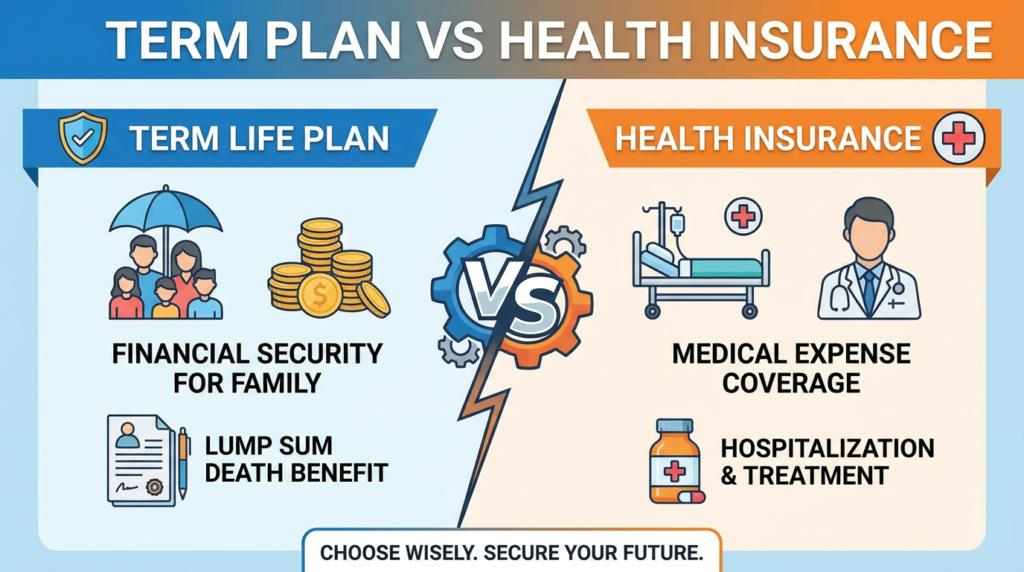
In the journey of financial planning, two pillars stand taller than the rest: Term Insurance and Health Insurance. While both fall under the broad umbrella of “insurance,” they serve fundamentally different purposes, protect against different risks, and offer distinct benefits.
Unfortunately, many people conflate the two or, worse, believe that having one negates the need for the other. This misunderstanding can lead to catastrophic financial gaps. If you have a health insurance policy but no term plan, your family’s future is at risk if you are no longer around. Conversely, if you have a massive term plan but no health insurance, a single hospital stay could wipe out your lifetime savings.
In this exhaustive guide, we will break down the nuances, benefits, mechanics, and differences between Term Insurance and Health Insurance to help you build an airtight financial safety net.
Part 1: Understanding Term Insurance – The Pure Life Cover
What is Term Insurance?
Term Insurance is the simplest and purest form of life insurance. It provides a predetermined sum of money (the Sum Assured) to your beneficiaries (nominees) if you pass away during the policy term.
Unlike “Endowment” or “Money-back” policies, a pure term plan does not have a savings or investment component. It is a “vanilla” product: you pay a premium for a specific period, and if the unfortunate event occurs, the insurer pays out. If you survive the term, usually, no money is returned. This simplicity is exactly why it is the most affordable way to get high-value coverage.
Key Features of Term Insurance
- High Sum Assured at Low Cost: You can get a coverage of $1 million (or several crores) for a fraction of the cost of other insurance products.
- Financial Security for Dependents: It is designed to replace your income. It helps your family pay off debts (mortgages, car loans), fund children’s education, and maintain their lifestyle in your absence.
- Fixed Premiums: In most cases, the premium you pay when you buy the policy remains the same throughout the entire duration.
- Rider Options: You can enhance a term plan with riders like “Critical Illness Cover,” “Accidental Death Benefit,” or “Waiver of Premium.”
Why Term Insurance is Non-Negotiable
If you are the primary breadwinner or have any financial liabilities, a term plan is a moral and financial obligation. It ensures that your “Human Life Value” is protected. Without it, your family’s dreams are vulnerable to the whims of fate.
Part 2: Understanding Health Insurance – The Medical Safeguard
What is Health Insurance?
Health Insurance (often called Medical Insurance) is a contract where the insurer agrees to pay for your medical and surgical expenses. This can happen in two ways: through “Cashless Treatment” (where the insurer pays the hospital directly) or through “Reimbursement” (where you pay and the insurer refunds you later).
As medical inflation continues to rise at 10–15% annually, even a minor surgery can cost a significant portion of a middle-class annual income. Health insurance ensures that a medical emergency doesn’t become a financial emergency.
Key Features of Health Insurance
- Hospitalization Coverage: Covers room rent, ICU charges, doctor fees, and medicines.
- Pre and Post-Hospitalization: Covers diagnostic tests and medications required before you are admitted and during the recovery phase after discharge.
- Daycare Procedures: Covers surgeries that don’t require a 24-hour stay, such as cataract surgery or dialysis.
- Cashless Network: Most insurers have tie-ups with hospitals where you don’t have to pay out of pocket.
- No Claim Bonus (NCB): If you don’t file a claim in a year, the insurer often increases your sum insured or discounts your next premium.
Why Health Insurance is Essential
Health insurance is for you while you are alive. It ensures you receive the best possible medical care without compromising on quality due to cost. It protects your hard-earned savings from being drained by hospital bills.
Part 3: The Core Differences – A Side-by-Side Comparison
To truly understand how these two differ, we must look at them through various lenses: Purpose, Payout, Duration, and Beneficiaries.
| Feature | Term Insurance | Health Insurance |
|---|---|---|
| Primary Objective | To provide financial stability to the family after the policyholder’s death. | To cover medical expenses incurred due to illness or injury. |
| When is it Paid? | On the death of the insured during the policy term. | During hospitalization or medical treatment. |
| Who Gets the Money? | The Nominee/Beneficiaries. | The Policyholder (or the hospital directly). |
| Policy Term | Long-term (usually 10 to 40 years). | Short-term (usually renewed annually or every 2-3 years). |
| Premium Factors | Age, smoking habits, occupation, and health status at the time of entry. | Age, medical history, location, and type of plan (Individual/Family). |
| Benefit Type | Lump sum payout (Fixed Benefit). | Reimbursement or Cashless (Indemnity). |
| Maturity Benefit | Generally none (unless it’s a TROP plan). | No maturity benefit; covers expire at the end of the year. |
| Nature of Risk | Covers the risk of “dying too soon.” | Covers the risk of “falling ill.” |
1. The Payout Mechanism
Term Insurance follows a “Defined Benefit” model. This means the sum is fixed. If you have a $500,000 policy, the company pays exactly $500,000 upon a valid claim.
Health Insurance usually follows an “Indemnity” model. This means the insurer pays for the actual loss. If you have $50,000 coverage but your bill is $10,000, the insurer only pays $10,000.
2. The Beneficiary
In Term Insurance, the policyholder never sees the money. It is designed for those who are left behind.
In Health Insurance, the policyholder is the primary beneficiary. The money is used to save the policyholder’s life or restore their health.
3. Renewal and Duration
Term Insurance is a long-term commitment. Once you lock in a premium at age 25, you pay that same amount until age 60 or 70.
Health Insurance is a recurring contract. Premiums usually increase every few years as you move into older “age slabs,” and medical inflation causes insurers to revise their pricing.
Part 4: Deep Dive into Term Insurance Variations
To choose the right plan, you must know the flavors available.
1. Level Term Insurance
The most common type. The sum assured stays the same throughout the policy. Simple and effective.
2. Increasing/Decreasing Term Insurance
- Increasing: The cover increases by a certain percentage every year to keep up with inflation.
- Decreasing: The cover reduces over time. This is often used to cover a home loan; as the loan balance goes down, the insurance cover goes down.
3. Term Return of Premium (TROP)
Many people feel “cheated” if they pay premiums for 30 years and get nothing back. TROP plans return all the premiums paid if the policyholder survives the term. However, the premiums for TROP are significantly higher than pure term plans, and the “return” usually doesn’t account for the time value of money.
4. Critical Illness Riders
This is where the line between Term and Health blurs. You can add a Critical Illness (CI) rider to a term plan. If you are diagnosed with a covered illness (like cancer or heart attack), the insurer pays a lump sum. Unlike health insurance, you don’t need to be hospitalized; the diagnosis is enough.
Part 5: Deep Dive into Health Insurance Variations
Health insurance is not a one-size-fits-all product.
1. Individual Health Insurance
Covers one specific person. Each person has their own sum insured.
2. Family Floater Plans
One sum insured covers the whole family (husband, wife, children). If the sum insured is $10,000, any member can use it. It is usually cheaper than buying individual plans for everyone, but if one person uses a large chunk, less is left for the others.
3. Senior Citizen Health Insurance
Specifically designed for those over 60. These plans often have shorter waiting periods for pre-existing diseases but may come with “co-payment” clauses (where the insured pays a percentage of the bill).
4. Top-up and Super Top-up Plans
These act like a “step-ney” for your insurance. They kick in only after a certain threshold (deductible) is crossed. They are a very cost-effective way to increase your total coverage.
Part 6: Tax Benefits – The Silver Lining
In many jurisdictions (like India under the Income Tax Act), both types of insurance offer significant tax savings.
- Term Insurance (Section 80C): Premiums paid are usually deductible from taxable income (up to a certain limit). The death benefit received by the nominee is also typically tax-free.
- Health Insurance (Section 80D): You get a separate deduction for health insurance premiums. This is often tiered—allowing for deductions for yourself/family and an additional deduction for premiums paid for senior citizen parents.
Note: Always consult a tax professional as laws vary by country and change frequently.
Part 7: Critical Factors to Consider Before Buying
For Term Insurance:
- The Multiplier Rule: A general rule of thumb is that your Term cover should be at least 10–15 times your annual income.
- Claim Settlement Ratio (CSR): Check the percentage of claims the company has settled in the past. Look for a CSR above 97–98%.
- Solvency Ratio: This indicates the company’s ability to pay out claims if a disaster strikes.
- Disclosures: Never hide your smoking habits or existing medical conditions. Non-disclosure is the #1 reason for claim rejection.
For Health Insurance:
- Room Rent Limits: Some plans limit you to a “General Ward” or a “Twin Sharing” room. Look for plans with no room rent caps.
- Waiting Periods: Every health plan has a waiting period for “Pre-Existing Diseases” (PED), usually 2–4 years. The shorter, the better.
- Inclusions and Exclusions: Does it cover maternity? Does it cover mental health? Does it cover robotic surgeries? Read the fine print.
- Co-payment: Avoid plans that require you to pay a percentage of every bill unless you are a senior citizen and have no other choice.
Part 8: The Synergy – Why You Need Both
Think of your financial plan as a castle.
- Health Insurance is the Moat: It protects you from the recurring “attacks” of illnesses and accidents. It keeps your wealth inside the castle.
- Term Insurance is the Shield: It is the ultimate protection. If the “King” or “Queen” (the earner) falls, the shield ensures the castle doesn’t crumble.
Scenario A: Only Health Insurance
John has $50,000 in health insurance but no term plan. He suffers a heart attack. The health insurance pays for the $20,000 surgery. John recovers, but a year later, he passes away in a car accident. His family receives nothing from the health insurance. They are left with no income and a mortgage to pay.
Scenario B: Only Term Insurance
Sarah has a $1 million term plan but no health insurance. She is diagnosed with a condition requiring a $40,000 surgery. Because she is still alive, the term plan pays nothing. She has to sell her investments and take a loan to pay the hospital. Her financial goals (retirement, kids’ college) are delayed by years.
Scenario C: Both Plans
Mark has both. When he gets sick, the health insurance covers the hospital. When he recovers, his savings are intact. If the unthinkable happens later, his term plan provides his family with enough money to live comfortably forever.
This is why insurance is not an “either-or” choice. It is a “both-and” necessity.
Part 9: Common Myths Debunked
Myth 1: “My corporate/employer insurance is enough.”
Reality: Corporate cover is usually low ($3,000–$5,000). More importantly, it ends the moment you quit or lose your job. If you develop a health condition while between jobs, no new insurer will cover you easily. Always have a personal policy.
Myth 2: “I am young and healthy, I don’t need insurance yet.”
Reality: This is the best time to buy. Premiums for term insurance are locked in based on your age at entry. If you buy at 25, you pay significantly less for the next 40 years than if you buy at 40. Furthermore, health insurance doesn’t cover diseases you already have; you want to get it while your “medical record” is clean.
Myth 3: “Insurance is a bad investment.”
Reality: Insurance is not an investment. It is an expense—a premium paid to transfer risk. You don’t buy a fire extinguisher hoping your house catches fire so you get your “money’s worth.” You buy it for peace of mind.
Myth 4: “Term insurance money is wasted if I survive.”
Reality: You paid for the protection you received during those years. The “waste” is the cost of knowing your family was safe. If you want money back, invest the difference between a term plan and an endowment plan in a diversified mutual fund; you’ll likely end up with much more wealth.
Part 10: How to Balance Your Portfolio
If you are just starting out, here is a step-by-step priority list:
- Step 1: Get a Basic Health Insurance Plan. Even a $5,000–$10,000 cover is a great start.
- Step 2: Get a Pure Term Plan. Aim for 10x your annual income.
- Step 3: Add a Critical Illness Rider. This provides a lump sum for major lifestyle-changing illnesses.
- Step 4: Enhance with a Super Top-up. As your income grows, add a Top-up to your health insurance to take your coverage to $50,000 or $100,000 at a very low cost.
Conclusion: Taking the First Step
The distinction between term and health insurance is clear: one protects your absence, the other protects your existence.
In the world of finance, we often focus on growth—stocks, real estate, and crypto. But growth without a foundation is a house of cards. Term insurance and health insurance are the foundation. They don’t make you rich, but they prevent you and your family from ever becoming poor.
Don’t wait for a “wake-up call” in the form of a medical diagnosis or a tragedy in your social circle. Evaluate your needs today. Calculate your Human Life Value for term insurance and assess your family’s medical needs for health insurance.
Buying insurance is an act of love for your family and an act of respect for your hard-earned savings. Secure both, and then go forth and invest with the confidence that your base is covered.
Summary Checklist for Readers:
- Do I have a Term Plan that is at least 10x my annual income?
- Does my Health Insurance cover my entire family?
- Does my Health Insurance have “No Room Rent Caps”?
- Have I disclosed all medical habits (smoking/pre-existing conditions) to my insurer?
- Do I have a personal health policy independent of my employer?
- Have I assigned nominees for my term plan?
Financial freedom begins with financial security. Make sure your safety net is woven tight.